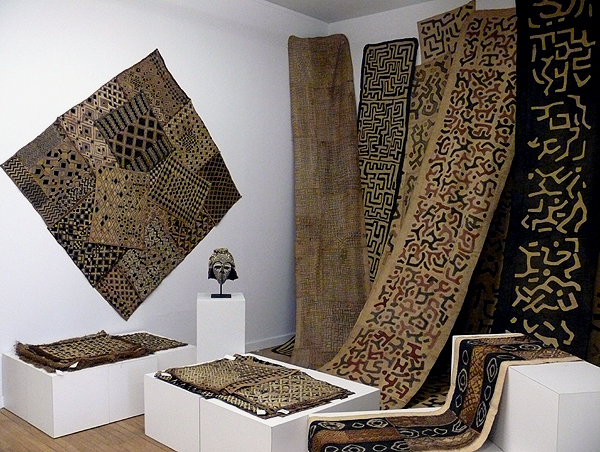
After my last post, and in contemplating how to combine "geometric" pattern, line, circles, squares, etc. in an more organic and less hard edged way in my painting, I came upon a Tumblr image that was described as "Ceremonial Cuban cloth) . . .
Image from Tumblr and it's link here.
This started a contemplative "journey" in my mind's eye, as to how to incorporate what I call "organic geometry" into some kind of abstract compositions on my painting surfaces.
Many, many years ago (I won't say how long ago!), I saw a piece of what was described to me as "bark cloth", which had been brought back with a couple from their trip to Australia. I think that was probably the first time I had ever seen anything like that. It was very large and the texture was wonderful and the designs were amazing. I never forgot it.
When I started seeing examples of a type of these designs on Tumblr from the Hamill Gallery in Boston, I learned that it is called "Kuba." Here are a few more examples from the Hamill Gallery, and in their description, they use the words repetition and rythym.
My very favorites are the patterns and repetitions in black and tan . . .
It wasn't until I decided to do this blog post, that I found out a little more about
the story behind the making of these beautiful designs, which I found on this African imports site. This link to this page on their site has a youtube video (that I don't know how to post here . . still learning) about the meaning of the cloth, which I find amazing . . . The Meaning of Kuba Cloth
African Kuba cloth is just starting to become popular in the United States. Using the leaf of the raffia tree, the Kuba people of the Congo first hand cut, and then weave the strips of leaf to make pieces of fabric, often called raffia cloth. There are several different sub groups of the Kuba people. Each group has different and unique ways to make the fabric. Some make it thicker, longer, shorter, or with different patches. Each patch is symbolic and many times a piece has many different meanings. When Kuba cloth originated there were probably no patches used, but as the cloth is brittle it is quite likely that the patches were used to repair the frequent tears. Later each patch developed a meaning, many patterns are uniquely arranged to tell a story.
TheMaking of Kuba Cloth The process of making Kuba cloth is extremely time consuming and may take several days to form a simple placemat size piece. The men first gather the leaves of the raffia tree and then dye it using mud, indigo, or substances from the camwood tree. They then rub the raffia fibers in their hands to soften it and make it easier for weaving. After they've completed the base cloth the women embroider it. They do this by pulling a few threads of the raffia fibers, inserting them into a needle running the needle through the cloth until the fibers show up on the opposite end. They then take a knife and cut off the top of the fibers, leaving only a little bit showing. Doing this hundreds of times forms a design. The designs are seldom planned out ahead of time, and most of the embroidery is done by memory. The Kuba people, who developed this and many other fabrics were very resistant to using European cloth; and for many years seldom used machine made fabrics. When researching this and other cloths that the Kuba people developed, it is not hard to understand why they resisted the change so much. Each fabric, each pattern, and each design in traditional Kuba fabrics has great meaning. On the basis of what a person wore; you could interpret much about them. Social status age, marital status, and a person's character were just a few of the things a piece of cloth symbolized to these people.
When I found this painting, by Kelly Marzycki, on her blog "Aesthetic Work", which, to me, reminds me of, or has the "flavor" of, Kuba cloth . . . well . . .viewing this piece was the synchronicity that drew me toward an inner reflection process that I write about here, how much I loved the organic nature of Kuba cloth . . organic yet with structure. Her painting is less structured yet still has that feel.
(Acrylic on nujabi paper)
Now I know that the patching results in the combination of seemingly dissimilar patterns, which I love visually (reminds me of Asian boro cloth), yet it also has symbolic meaning. The following are images of kuba inspired patterns in my living room. I also love zebra patterns, although that may come from liking a black/white palette, but the pattern is also organic.

A wall hanging in my living room
Pillow from Ikea on my couch
This cloth covers my piano
Another pillow from Ikea . . although not organic, I like the repetition
Not Kuba . . but here's the circle!
Detail of my living room rug (wool not zebra!)
This juxtoposition of pattern, rythym, repetition, grids, yet so organic fascinates me. I don't know at this point, where this all will take me in my painting, but I wanted to share with you what is feeling very exciting to me. All of you don't know my "story", but there is a whole lot that has "percolated" within me thoughout my life, that I am discovering, and it seems to be, at one time . . erupting . . at another time . . a quiet blooming . . . and . . rather late in life. It has been feeling lately very rich and deep, and I'm having thoughts that all this may be fodder for a book. Ha!!! . . who knows! After all . . . one never really knows what tomorrow will bring, as long as one keeps moving and doing . . and paying attention . . not remaining rigid and opening to new possibilities . . and, I believe, the Universe does the rest.